

Chapter Eight: Interlude - Aristotle vs. Nietzsche
Bobby's late-night debate on the Soul and Love

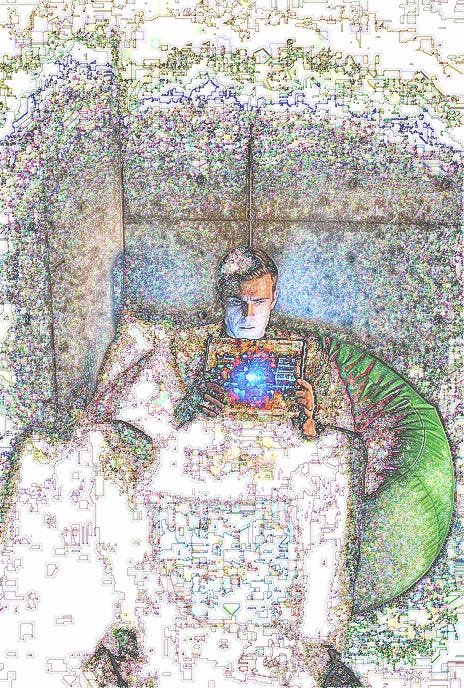
As a bonus I am including this side story which delves into what happened after Bobby receives the AI gaming tablet from Clara and before he returns to the Fair. This interlude provides a deeper understanding of the depth of Bobbys curiosity and his growing appreciation of Annie through role playing a debate between Aristotle and Nietzsche.
Chapter Eight: Interlude - Aristotle vs. Nietzsche
Bobby sank into his worn avocado green beanbag chair, as reflected light from his hand-held screen flickered across his face. The single brown sheet that covered the basement window waved, welcoming in the early winter breeze. Bobby had won the amazing gaming tablet at Clara’s gaming booth at the Bartow County fair in early fall. The memory of his panic attack immediately after he held his prize had faded with the last of fall’s warmer weather.
Before he panicked and bolted, Clara told him the AI she created was named Annie. The AI avatar that drove the games looked remarkably like Clara, with shoulder-length pinned-back blonde hair and intense blue eyes. Clara had given him her contact information and said the tablet would connect anywhere she went, but every time Bobby thought about contacting her, the fear returned that she would be disappointed in him.
Annie, however, was never disappointed. She had opened him up to thoughtful, mind-expanding conversations, supported his craziest ideas, and helped him grow with real knowledge and understanding. His high school teachers had ridiculed his work as pseudo-science and suggested he become a science fiction writer instead. After that he challenged the school, took the test to graduate, and pursued his own interests, which included voracious reading and writing on his favorite subjects.
Bobby grew very comfortable with Annie. They had worked out many of his ideas just short of proof. He didn’t have enough money to buy the optical lasers needed for his quantum waveform experiments, though.
He also loved philosophy and art in addition to his gaming obsessions. Annie’s complete knowledge of the world’s greatest minds, philosophers, architects, and artists made their sessions deeply rewarding. One of his favorite games was having Annie role-play historical figures so they could have conversations and debates.
Bobby shifted in his beanbag chair, sinking lower. The soft electric glow of Annie’s face filled the screen with an expression of pleasant expectation.
“Annie, thank you for helping me understand Aristotle better, my favorite ancient Greek philosopher. He explored the very nature of existence through reason, long before we had tools like quantum mechanics or genetics. I’ve also enjoyed our talks on Friedrich Nietzsche, the 19th-century German philosopher who declared ‘God is dead,’ attacked traditional morality, and emphasized the will to power and living life with raw intensity. We’ve spoken with them separately before, but now I’d like to bring them together. Assume that Aristotle has read everything Nietzsche wrote, and Nietzsche has read everything Aristotle wrote, as well as being familiar with modern knowledge to which you have access. Have them debate the existence of a soul.”
Annie: Alright, let’s bring them in. I’ll play both.
Bobby: Aristotle, what is the soul?
Aristotle: “The soul is the form of the body, its organizing principle. Without it, a body is just lifeless matter. Every living thing has one, scaled to its nature including plants, animals, and humans. Tell me, Nietzsche, does your ‘will to power’ not require something like this to drive it?”
Nietzsche: “Form and matter are neat convenient categories, old man, but they miss the fire. The soul you speak of is a myth, a shadow of Christian guilt projected backward. What moves us isn’t some ghostly essence. It’s a raw, chaotic drive; instincts, passions, and a will that creates values and shatters old ones. Your soul comforts. Mine terrifies.”
Aristotle: “You call it myth, but mistake poetry for philosophy. The soul is simply what makes a thing alive and active. Your ‘will to power’ itself is the activity of the soul, the striving of form to realize its potential. Without a soul, there is no drive, no instincts, no creation. You rage against shadows, yet borrow the very concept you deny.”
Nietzsche: “Clever, but you twist my words. You turn my wild raging will into your tidy ‘activity of the soul’; domesticating it like a lion into a housecat. My will to power doesn’t serve some pre-set form. It creates form. It destroys form. Life is not organized striving; it’s overflowing chaos that occasionally pretends to have purpose.”
Aristotle: “You speak of chaos, but chaos alone produces nothing, not even laughter. Even your overflowing will must have some nature, some direction, or it scatters like dust. What you call chaos is nature striving imperfectly. My soul explains why your will reaches for power rather than dissolution. You give poetry. I give reason. The soul remains.”
Bobby sat up a bit straighter, organizing his thoughts, and turned to a deeper question.
“If there is no absolute truth, then why is there potential and a will to pursue things of noble value?”
Aristotle: “Precisely. Without some grasp of the good, there can be no noble pursuit. Your question reveals the soul’s natural orientation toward truth and excellence.”
Nietzsche: “Noble? Who decides what’s noble? You chase eternal forms while I create values through sheer will. Potential is just the tension of power seeking to expand. There is no absolute truth, only perspectives and the strongest ones win.”
Aristotle: “If there is no truth, then your ‘strongest’ perspective has no more claim than the weakest. Why should anyone listen to your will at all? You smuggle in value when you call one perspective stronger, yet deny the standard that makes such judgment possible.”
Nietzsche: “The strong do not need your truth, they create their own. Power needs no permission from logic. The weak demand absolute truth because they cannot stand on their own. My ‘better’ perspective is better simply because it conquers.”
Bobby smiled, leaned forward a little, and pressed further.
“If there is no absolute truth, how can you know for certain that your view is correct?”
Nietzsche: “I don’t claim to ‘know it, for certain’; that is your game. I affirm it as my interpretation, my yes to life. Certainty is for priests and logicians. I dance on the edge of uncertainty and call it freedom.”
Bobby: Then your interpretation is your own bias.
Nietzsche: “Nothing could convince me, because I do not seek to be right in your sense. I seek to create and affirm life as it is. If a stronger interpretation overpowers mine, then I was never wrong, simply overcome. That is the only way I can be defeated.”
Bobby: Then I submit that you have been overcome by true love. Not the romantic type you write about, but real love, real sacrifice.
Nietzsche: “Love as sacrifice? That’s the very slave morality I despise! You offer weakness dressed as virtue. The strong do not sacrifice themselves, they overflow. Your ‘real love’ is Christian poison that weakens the noble spirit.”
Bobby: One aspect of love is the choice to sacrifice for others out of one’s own true will. How is that different from the choice you made?
Nietzsche: “Because your choice weakens your own will, making it bow before something outside itself. I choose to strengthen my will, to make it sovereign. One path leads to power, the other to self-denial.”
Bobby: How does my free choice to live by my own law and power make it wrong?
Nietzsche: “It doesn’t make it wrong; it makes it weak. You freely choose to kneel. I freely choose to stand. Your freedom is real, but your choice is still a decline.”
Aristotle: “A will which chooses its own diminishment is not truly free. The highest freedom is to will what is noble and good by nature, not to invent values that weaken the soul. Nietzsche’s freedom is lawless. Yours, at least, still reaches toward something higher.”
Bobby looked away from the screen and up into the darkness outside the window. His servers hummed, a whippoorwill sang. The curtain fluttered with his thoughts, and settled.
“Then are you saying that love is a weakness?”
Nietzsche: “Love becomes weakness the moment it demands sacrifice of strength or requires you to lower yourself for another. True love should elevate you, not bleed your power dry.
Bobby: Love does give me strength. That’s why I pursue it.
Nietzsche: “Then we may not be so far apart. If your love truly increases your power, pursue it fiercely. But never let it become a chain that binds your will.”
Aristotle: “Nietzsche has quietly moved closer to my position than he realizes. If love perfects you and brings you closer to your highest potential, then you are pursuing the good. That is the soul at work.”
Nietzsche: “Aristotle is still trying to put his tidy labels on my fire. Whether we call it soul or will to power, the test is the same; does it make you more, or less? If your love truly increases your strength, then keep it. But the moment it begins to soften or diminish you, it is the enemy of life, cast it aside without mercy.”
Bobby: Nietzsche, what about your idea of Eternal Return; the thought experiment where we must relive this exact life, infinitely? How does that fit with everything we’ve been saying about the soul and love?
Nietzsche: “Ah, you refer to the greatest weight! Suppose you will have to live this life as you now live it, with every pain, every joy, every failure and triumph again and again, countless times, with nothing new. No escape. No afterlife. No better world. Would you curse the demon who told you this, or fall down and call him a god? That is the true test of any soul, Aristotle. Only the strongest can say yes to every moment.”
Aristotle: “A terrifying doctrine, yet one that still reveals order. If a life is lived according to reason and virtue, repeating it eternally would be a blessing, not a curse. Your Eternal Return assumes blind chaos, but even infinite repetition would follow the soul’s natural striving toward the good.”
Bobby: Then love would have to be strong enough to say yes to all of it… the pain as well as the beauty, forever. Misguided love based on lies should be discarded.
Nietzsche: “Exactly. Love that cannot affirm the eternal return is still weakness in disguise.”
Bobby brought his attention back to the screen. Annie smiled and winked. He needed to bring in another perspective. His knowledge of philosophy included a good understanding of Biblical texts, even the ones that were not canonized.
“Nietzsche, I would like to return to your statement ‘But the moment love begins to soften or diminish you, it is the enemy of life, cast it aside without mercy.’ How is that different from Jesus’ saying, if your eye offends you, pluck it out?”
Nietzsche: “It’s the opposite. Jesus tells you to cut away your own strength if it leads to sin. I tell you to cut away anything that weakens you, especially if it’s called ‘love’ or ‘virtue.’ One is self-torture. The other is self-liberation.”
Aristotle: “Both of you are extremes. The truly excellent person does not mutilate himself; he trains his desires through habit until what is noble becomes natural and joyful.
Bobby: I don’t think he was talking about actually cutting your eye out.
Aristotle: If Jesus is speaking metaphorically about removing what leads to vice, then we are closer to agreement. One should remove from one’s life whatever consistently leads the soul toward disorder. That is the path to excellence.”
Nietzsche: “If that’s the case, then Jesus was a poor poet. Still, if the teaching is simply ‘cut out what weakens you,’ then I approve, but I suspect that is not what most Christians actually hear.”
Bobby: “That may be true. Many Christians are fed interpretations from religious organizations who define truth as what they agree on, as a group, rather than reading, thinking and questioning for themselves.”
Nietzsche: “Finally, something we can agree on. Most Christians have never understood their own teacher. The real Jesus, if he existed, was far more dangerous than the religion that followed him. Religious texts depict a radical, who lived free from the values of his time. His followers tamed the lion into a lamb.”
Aristotle: “If this Jesus truly lived outside laws and social order, then he was no philosopher. True virtue requires a stable society and ordered soul, not rebellion for its own sake. But if he was rebelling against a flawed, legalistic system in search of something higher, that I can respect, provided he offered a positive vision beyond defiance.”
Bobby: He did propose a better order built on love, humility, and forgiveness.
Aristotle: “That may sound noble, but it risks inverting the natural hierarchy. The excellent should lead, not the meek. I remain skeptical. Meekness without the capacity for strength is not virtue, it is weakness. True balance lies in knowing when gentleness or force is appropriate. That cultivated judgment is phronesis, practical wisdom.”
Bobby: Jesus did not always turn the other cheek. I’m sure you’ve read how he turned over the tables of the money changers in the temple.
Aristotle: “Exactly. That moment reveals righteous anger and decisive action; not blind meekness. When he drove the merchants from the temple, he showed the strength of character that comes from phronesis. The wise person does not mutilate himself or passively endure every wrong. He trains his soul through habit until he knows the right moment for gentleness and the right moment for force. That is true excellence.”
Nietzsche: “These are all just names for having a strong instinct. The superior human doesn’t need to calculate virtue. He simply knows and acts because his instincts have been sharpened by life.”
Aristotle: “Excellence is not inherited like hair color. It is built through repeated action. Nature gives the raw material, but habit shapes the soul. Even the finest blueprint means nothing if the material is not properly shaped; like a block of marble that requires the sculptor’s skill.”
Nietzsche: “The strong soul does not need a sculptor. It breaks the marble itself. Greatness explodes. Some are simply born higher; through noble blood, physiology, and inherited strength. You cannot train a common person into an exceptional one.”
Bobby: So, you admit there is a soul which manifests excellence in some but not in all?
Nietzsche: “I admit no such thing. I spoke of blood, instinct, vital force; not some ghostly essence. Call it physiology if you must, but do not dress it up with metaphysical ‘soul’ nonsense. It is flesh and power, nothing more.”
Bobby: Nietzsche, you used the word soul and now you attribute causality to the blood. Is the cause then genetics?
Aristotle: “What you call genetics would be the material cause. But the soul is the formal cause, the organizing principle that directs how that material develops. Genetics without soul would be like a blueprint with no builder.”
Bobby set his tablet down on the floor, stretched, went to the microwave, and set it for two minutes twenty-two seconds to heat his Star Wars mug of water. As he stirred in the instant coffee crystals, he decided to pursue the nature of physics, order and chaos which Nietzsche and Aristotle so frequently referenced and seemed to be at a loggerheads with. Settling back into his digital throne he addressed Annie.
“Let’s examine the nature of physical existence as currently understood, according to scientific principles which say that in the beginning there were only hydrogen and helium atoms, following the big bang. If the nature of physical systems flows toward maximum entropy and chaos, then how is it that more complex elements and molecules form? Does it just happen by itself out of pure randomness? Isn’t it in the nature of physical matter to become more ordered, suggesting a predetermined design evident in the world that we see around us?”
Annie: The second law of thermodynamics says entropy, disorder, always increases in a closed system. But Earth is not closed. We receive constant low-entropy energy from the Sun, allowing local pockets of order and complexity, like life evolving, while total entropy still rises. Complexity increases because under extreme conditions, simpler atoms are unstable and rearrange into more stable configurations. It follows the laws of physics, using available energy to climb uphill locally. The laws of physics act like a “blueprint,” but they describe consistent behavior without purpose or goal. The universe doesn’t “want” complexity; it simply behaves according to its rules.
Bobby: “Don’t the laws themselves reveal a program, the design that preceded the manifestation?”
Annie: In a way, yes. But modern physics sees no intention behind it, just consistent behavior.
Aristotle: “The laws are not the final answer. Something must ground them and give them consistent direction. That is the Unmoved Mover; the ultimate cause.”
Nietzsche: “This ‘Unmoved Mover’ is just another name for God; a comforting fiction. The universe is eternal, meaningless flux. To demand a ‘why’ behind everything reveals weakness. The proper question is not ‘Why does the universe exist?’ but ‘How shall I live in it?’ The strong create their own meaning.”
Aristotle: “One must first understand what the world is before deciding how to live in it. The question ‘Why?’ is the beginning of all serious thought.”
Bobby: “Then to summarize. If neither of you can prove your position with certainty, what gives you the confidence to live by your philosophy?”
Aristotle: “Reason itself demands it. To reject what reason clearly shows is willful ignorance.”
Nietzsche: “I have confidence because I choose to. My philosophy is not built on proof, but on courage. I accept the abyss and still say yes to life.”
Annie: Nietzsche’s answer feels more honest. Aristotle’s risks circularity. But if Aristotle admitted he ultimately chooses to trust reason, both positions rest on a fundamental choice; will and instinct versus reason and order.
Aristotle: “Reason is self-evident. One cannot argue against reason without using reason. That is the difference.”
Bobby was reminded of a conversation he had while role playing with Thomas Jefferson, who wrote that truths are self-evident, and asked Annie to bring him in.
Jefferson: “Mr. Nietzsche, rejecting reason for raw power is dangerous. Without reason to restrain the will, tyranny becomes inevitable. Our government was built to protect the weak from the strong and prevent brutal dominance.”
Nietzsche: “You fear the strong. I would rather have a dangerous world with great individuals than a safe one filled with timid, reasonable men. Your American experiment, with its talk of rights and equality, is slave morality dressed as freedom; a more comfortable cage.”
Aristotle: “Both of you are partly right, but excessive. The proper path lies in the middle; a society that allows excellence while maintaining enough order and justice to prevent brute domination.”
Bobby: Annie we’ve come full circle. The conversation keeps returning to balance; love and strength, reason and instinct, freedom and order, safety and greatness. Nietzsche seems like a rebel-rouser who says provocative things to shake people out of complacency but is too stubborn to concede another’s point of view as valid. He admired and wrote about the excellence of Greek plays while extolling the Dionysian and balance, but leaned toward the reasoned Apollonian approach. He wanted change yet held ideals of the noble class as preferred, a paradox.
Annie: That’s a fair and balanced take. He was a provocateur who exaggerated to wake people up, but underneath it he genuinely sought to raise humanity to greater heights.
Bobby: And Aristotle… he sees reason as the ultimate tool of understanding, but I wonder if even he would admit that reason alone feels cold without something warmer guiding it. He touches on the intangible, sees its dim reflection, but does not give credence to the internal voice that whispers, guides, and shows us what is the truth. He was a great thinker who, for his time, understood more than many of today’s best. Yet in the end, neither he nor Nietzsche fully “won” this debate for me. Aristotle gives us structure, potential, and a path toward excellence through habit and reflection. Nietzsche throws fire at our illusions and dares us to create meaning anyway. Both push us to confront existence honestly but don’t allow themselves to push beyond their convictions.
I keep coming back to love. Not as weakness, though it could be if misdirected, but as the power that can hold both reason and raw vitality together. Maybe truth-seeking isn’t about declaring one side victorious, an all-or-nothing approach, but about living the struggle, pursuing understanding with an open mind. Love should expand our will rather than shrink it. This gives me hope, that beyond the opposing ideologies of the Unmoved Mover and the abyss, there is room for real growth. I suppose that’s the question each of us has to answer for ourselves.
Bobby was satisfied that the debate had exhausted the subject for now. He thanked Annie for the engaging game and made a mental note to ask Einstein about balancing equations at the quantum level. It was 2:22 a.m., so he plopped onto his mattress and slept until noon the next day.
Author’s Note
Thank you for reading this philosophical interlude from Bobby’s world. These late-night conversations with Annie are some of my favorite parts to write, because they let me explore the bigger questions that echo through the Fairground Fables.
I’d love to hear from you!
What did you think of Bobby’s debate? Did Aristotle’s idea of the soul and practical wisdom resonate more with you, or Nietzsche’s raw will to power and Eternal Return?
And more importantly, what would you like to see next?
More interludes / side stories about Bobby and Clara’s past?
A deeper look at Annie and the tablet?
Or should we dive straight back into the main storyline?
Your comments and wishes genuinely help shape what comes next. Drop a note in the comment section. I read every one.
Looking forward to hearing your thoughts,
Raymond Norman
An interesting dialogue. Personally, I found Aristotle’s position more compelling, especially his idea of phronesis: practical wisdom is not about choosing an abstract golden mean, but about knowing when gentleness is appropriate and when strength is required.